Can Synthetic Cedar Shake Be Used on Curved Roofs, Turrets, and Dormers?
Key Takeaways
- Turrets, flared eaves and dormers were traditionally finished in cedar shake and slate. Composite roofing carries that timeless charm forward without the maintenance.
- Enviroshake’s cedar-derived profiles, multiple widths and on-site cutting make it well suited to curves, turrets and small roof sections.
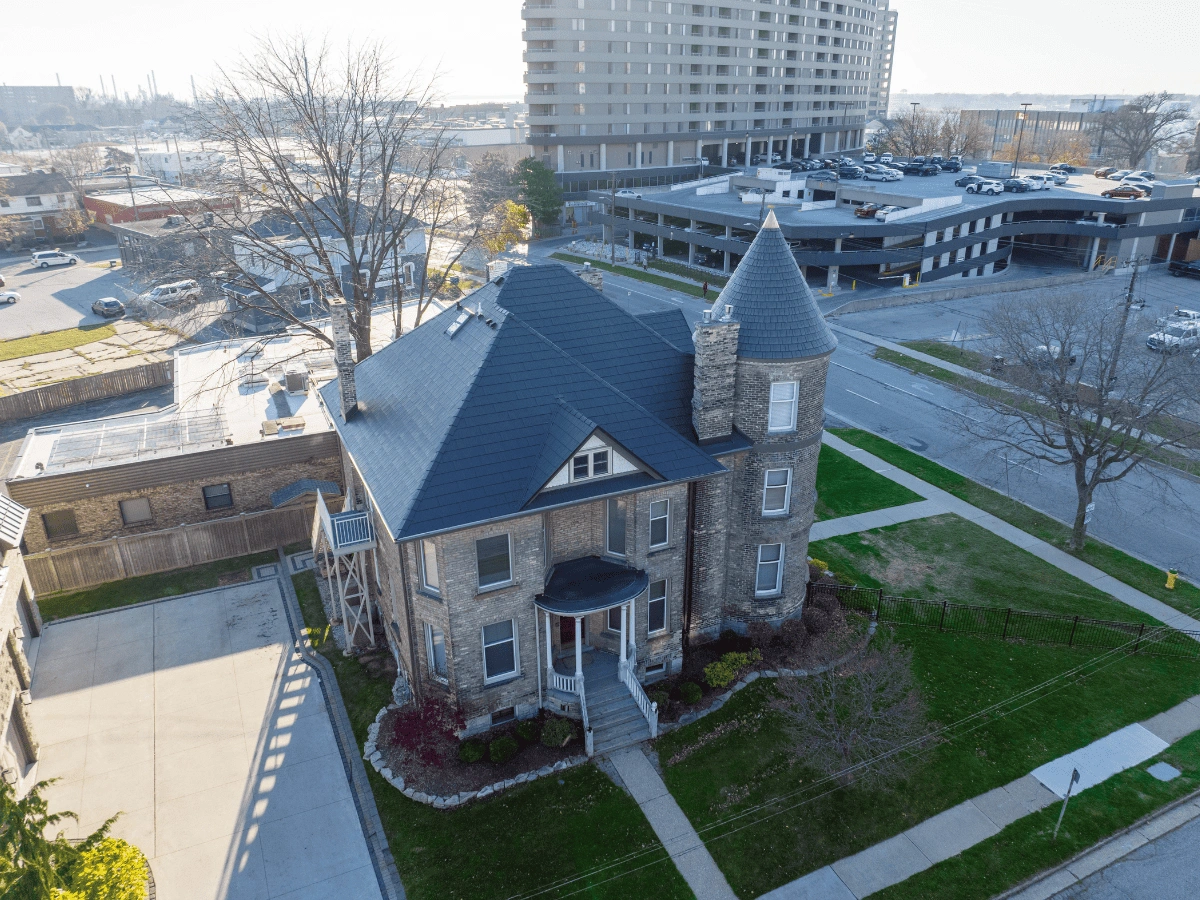
- On turrets, Enviroshake recommends split shakes to follow the curve, as on a 120-year-old home in Sarnia, Ontario.
- Class 4 impact resistance, 180 mph wind testing and no rot or treatments make composite shake ideal for features that are hard to reach and maintain.
- Complex roofs reward early planning, from course layout and valley flashing to extra material for cutting and a factory-trained installer.
Some of a home’s most memorable details live at the roofline. A rounded turret, a gently flared eave or a procession of dormers can define the character of an entire exterior, giving the home a silhouette that stays with you long after you’ve driven past. When the time comes to replace the roof, choosing a material that honors those details is one of the most important decisions in preserving what makes the home special.
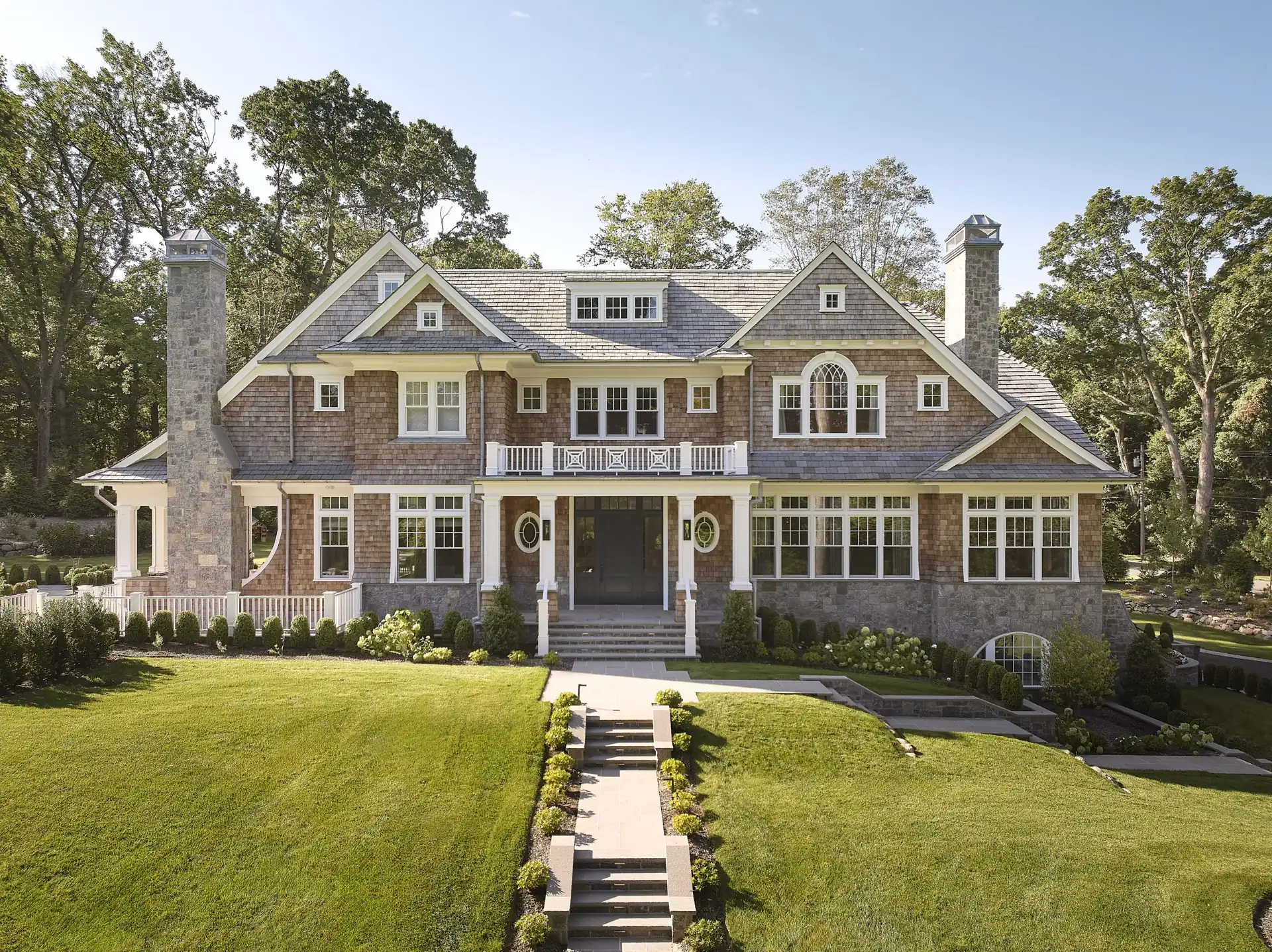
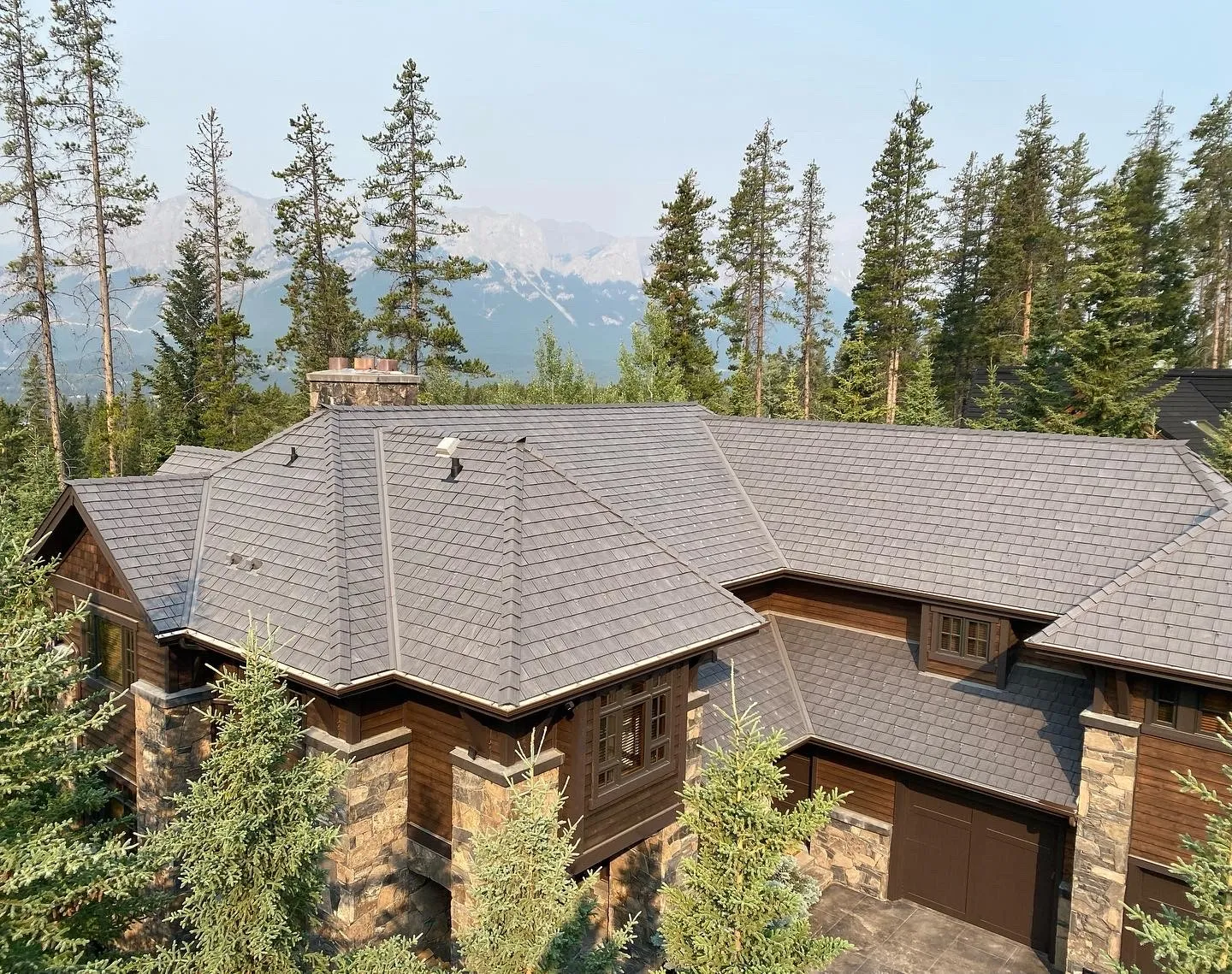
For generations, these distinctive rooflines were finished in natural cedar shake and slate, materials prized for their texture, depth and timeless charm. Today, intricate rooflines can make the choice of a replacement feel more complicated, but they don’t have to mean settling for flat, uniform asphalt, or taking on the upkeep of natural materials. With profiles derived from real taper-sawn cedar, substantial depth and subtle color variation, composite cedar shake brings the same richness to every curve and angle, while delivering the long-term performance of a modern engineered roof.
From historic turrets to coastal homes with sweeping eaves, Enviroshake installations show how premium composite roofing can elevate even the most distinctive architecture. Here’s why composite cedar shake is so well suited to these unique applications, and what to plan for when your roof has a little more character.
A Tradition of Shake and Slate on Distinctive Rooflines
Turrets, towers and sculpted rooflines have long been the signature of some of North America’s most beloved architectural styles. In its guidance on roofing for historic buildings, the U.S. National Park Service points to “the turrets of Queen Anne, the Mansard roofs, and the graceful slopes of the Shingle Style and Bungalow designs” as examples of roofing used as a major design feature. On homes like these, the roof doesn’t simply cover the house. It defines its style.
Natural cedar shake and slate became the materials of choice for these homes for good reason. Both are installed as small, individual pieces that can follow a curve, wrap a turret or step neatly around a dormer. Cedar brought warmth, grain and the soft, layered shadow lines that give a roof its depth, a quality explored in cedar shake’s architectural appeal. Slate brought a refined, enduring elegance to Victorian, Tudor and Second Empire designs. Together, they established the look many homeowners still picture when they imagine a classic turret or dormer.
That beauty has always come with trade-offs. Natural cedar requires regular inspection, cleaning and treatment, and over time it is prone to the rot, moss, curling and splitting that shorten its life. Those demands are only magnified on a turret or steep dormer, where every repair is harder to reach. Untreated wood is also combustible, and some insurers are dropping cedar shake roofs altogether. Natural slate, meanwhile, is heavy and costly, and requires specialized expertise to install and repair.
The good news is that choosing a modern, engineered roofing material no longer means giving up the timeless charm that made these materials so cherished. Composite cedar shake and composite slate are designed to carry that character forward, without the maintenance and vulnerabilities that came with it.
Why is Composite Cedar Shake Ideal for Complex Rooflines?
Turrets, dormers, curved sections and multiple intersecting slopes are all well suited to synthetic cedar shake, provided the roof design meets the product’s application requirements. On homes with steep gables and projecting dormers, the roof occupies a prominent share of the exterior, and its texture, depth and color deserve the same thoughtful consideration as the stonework, siding and trim. Several qualities make Enviroshake especially well suited to these demanding applications.
Authentic Cedar Character, Piece by Piece
Enviroshake’s profiles derive from 3D images of real taper-sawn cedar shakes, capturing the grain and surface detail of natural wood. Each shake measures approximately ½" thick at the butt, tapering toward the top, so overlapping courses cast the defined shadow lines that give cedar roofs their crafted, layered look. Multiple profiles and factory-shuffled bundles distribute that variation naturally across the roof, avoiding an obvious repeating pattern, an important detail on a turret or dormer where the roof is viewed up close and from many angles. Learn more about the qualities to preserve when replacing cedar.
.webp)
Multiple Widths for Tight Curves and Small Sections
Each Enviroshake profile is 12" wide, and most are formed to look like two narrower shakes, in combinations such as 4"–8", 5"–7" and 6"–6". Installers can snap these apart along a simulated keyway to create smaller pieces, giving them the flexibility to follow a narrowing turret, fit a small dormer roof or work around a curve while keeping the courses proportional.
Performance Where It’s Hardest to Maintain
The most distinctive features of a roof are often the most difficult to reach, which makes a low-maintenance material especially valuable. Enviroshake will not rot, blister, peel or crack, resists moss, lichen and insects, and requires no staining, sealing or preservative treatments. It carries a Class 4 impact rating (UL 2218), has been third-party tested for wind resistance up to 180 mph, and is available with a Class A fire rating. See the full list of testing and certifications.
Color That Lasts
Engineered with advanced UV inhibitors, Enviroshake weathers over its first six months to a year into a natural, matte tone that it then maintains. Unlike natural cedar, whose appearance shifts continuously as it ages, a composite roof keeps a consistent color across every turret, dormer and gable, so the whole composition continues to read as one. Explore roof color ideas by home style to find the right palette for your architecture.
A Sustainable, Lasting Investment
Manufactured from 95% post-industrial recycled materials, Enviroshake has an expected lifespan of 50+ years and is backed by a fully transferable limited lifetime warranty. For homeowners weighing a second round of natural cedar, our comparison of Enviroshake vs. cedar outlines the long-term differences.
Explore Enviroshake composite cedar shake roofing
Turrets: Preserving a Home’s Crowning Feature
A turret naturally draws the eye upward, making the arrangement of each roofing piece especially visible. Historically finished in cedar or slate, the turret is often the single most recognizable feature of a Queen Anne or Victorian home, and the one most worth preserving with care.
As the roof narrows toward its peak, the courses require a layout that follows that changing shape, wrapping around the turret rather than running across a single flat plane. Enviroshake’s installation guidance recommends using split shakes rather than full-width shakes on turrets to best accommodate the curve, and exposure may be reduced through transition areas so the courses remain consistent as the radius tightens. Layout, cuts, fastening and the finishing detail at the top all deserve careful planning before work begins.
In Sarnia, Ontario, Cheshire Roofing replaced the failing cedar shakes on the turret of a 120-year-old home with Aged Cedar Enviroshake. The result preserves the warm cedar character of the home’s most distinctive feature, now with the durability of an engineered composite roof that won’t require regular treatment high above the street.
See the Sarnia cedar replacement project
Curved and Flared Rooflines
A flared eave softens the lower edge of a steep roof, and above a porch or bay window, that gentle change in direction can become the focal point of the home’s design. Bell-cast eaves and eyebrow curves have been hallmarks of Shingle Style, Cape Cod and cottage architecture for well over a century, and they have traditionally relied on the small, overlapping units of wood shakes to trace their sweep. The cedar shake tradition on Cape Cod is a beautiful example.
On suitable designs, composite shake follows these sweeping edges and rounded forms beautifully, with overlapping courses tracing the roof as it curves toward the eave. Curved cuts can be made with a jigsaw, and exposure can be adjusted through the transition so the courses flow smoothly from one plane to the next. Enviroshake is also dimensionally stable, expanding and contracting less than 2% between seasons, with a required 3/8" gap between shakes to accommodate that movement. Paired with an accent such as copper edging, the shake texture gives even a modest section of roof a distinctive presence within the larger exterior.
Because the curve and changing slope determine the detailing needed, each flared or rounded section should be reviewed with your contractor before installation.
Dormers, Valleys and Intersecting Gables
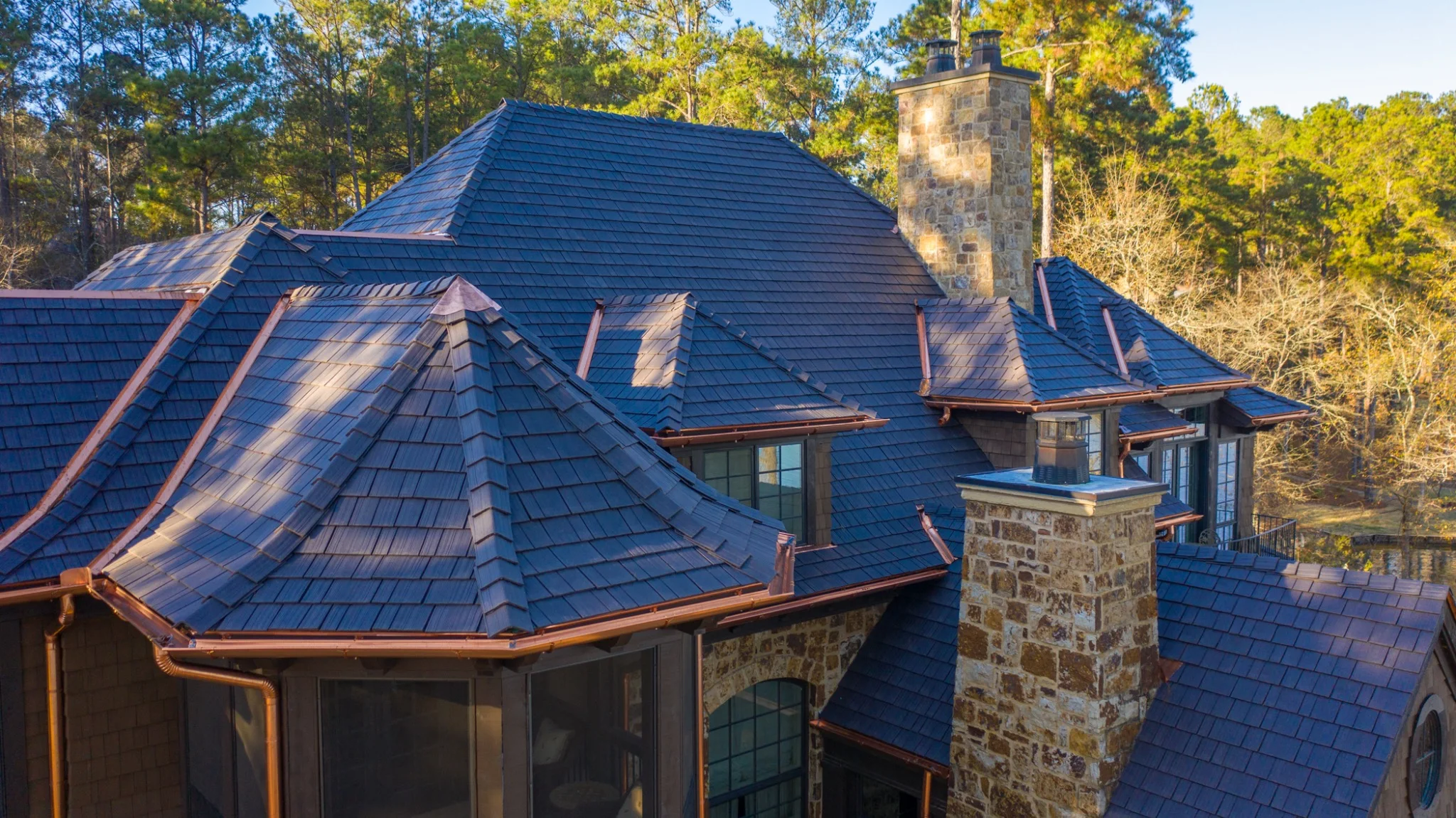
Dormers break a larger roof into a series of smaller surfaces, adding rhythm and visual interest to the home’s profile. Carrying the same shake texture across every slope ties these sections together, creating a cohesive composition even where the roof changes direction several times.
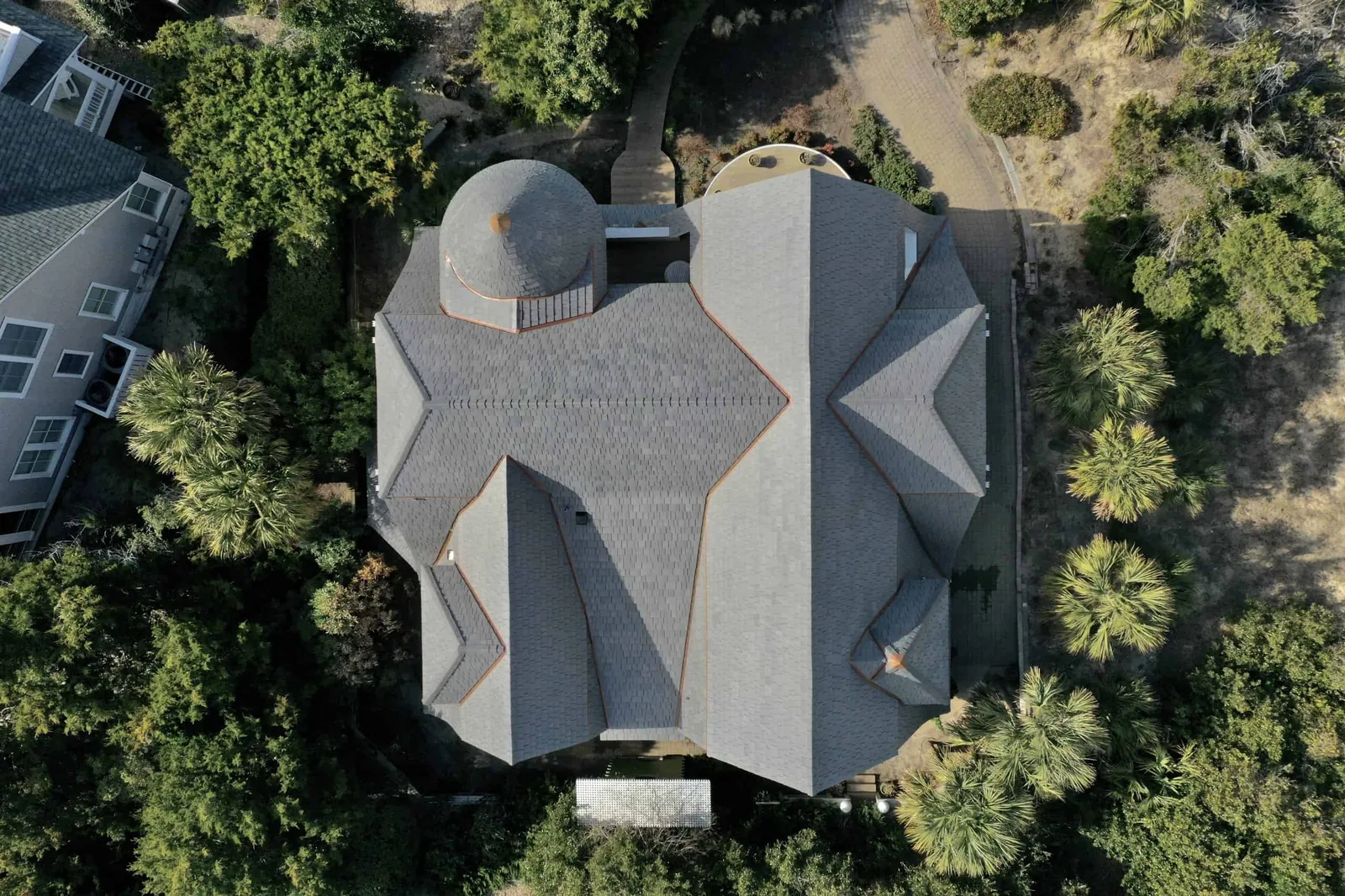
Seen from above, one roofing material can unite remarkably different forms. Broad gable slopes sit beside smaller dormer roofs and a rounded turret, with consistent color connecting the whole while the shake texture gives each surface its own definition.
Behind that seamless look, the intersections do the hardest work. Valleys, dormer sidewalls and roof-to-wall junctions are where water concentrates, and where moisture-sensitive materials like natural cedar tend to show wear first. Enviroshake won’t rot in these areas, and its installation guidance calls for a 24" W-style valley flashing, with heavy-gauge copper recommended, over Enviroshield underlayment or a 36" ice and water barrier. Learn more about the types of roof valleys and why underlayment matters.
Where slopes meet at hips and ridges, Enviroshake’s rigid hip and ridge caps are custom formed for a wide range of roof pitches, giving each intersection a crisp, finished line. Fasteners matter too: stainless steel nails are an option for every installation and are highly recommended in coastal areas. Read our guide to galvanized vs. stainless steel fasteners.
Geometric, Gambrel and Unconventional Roof Shapes
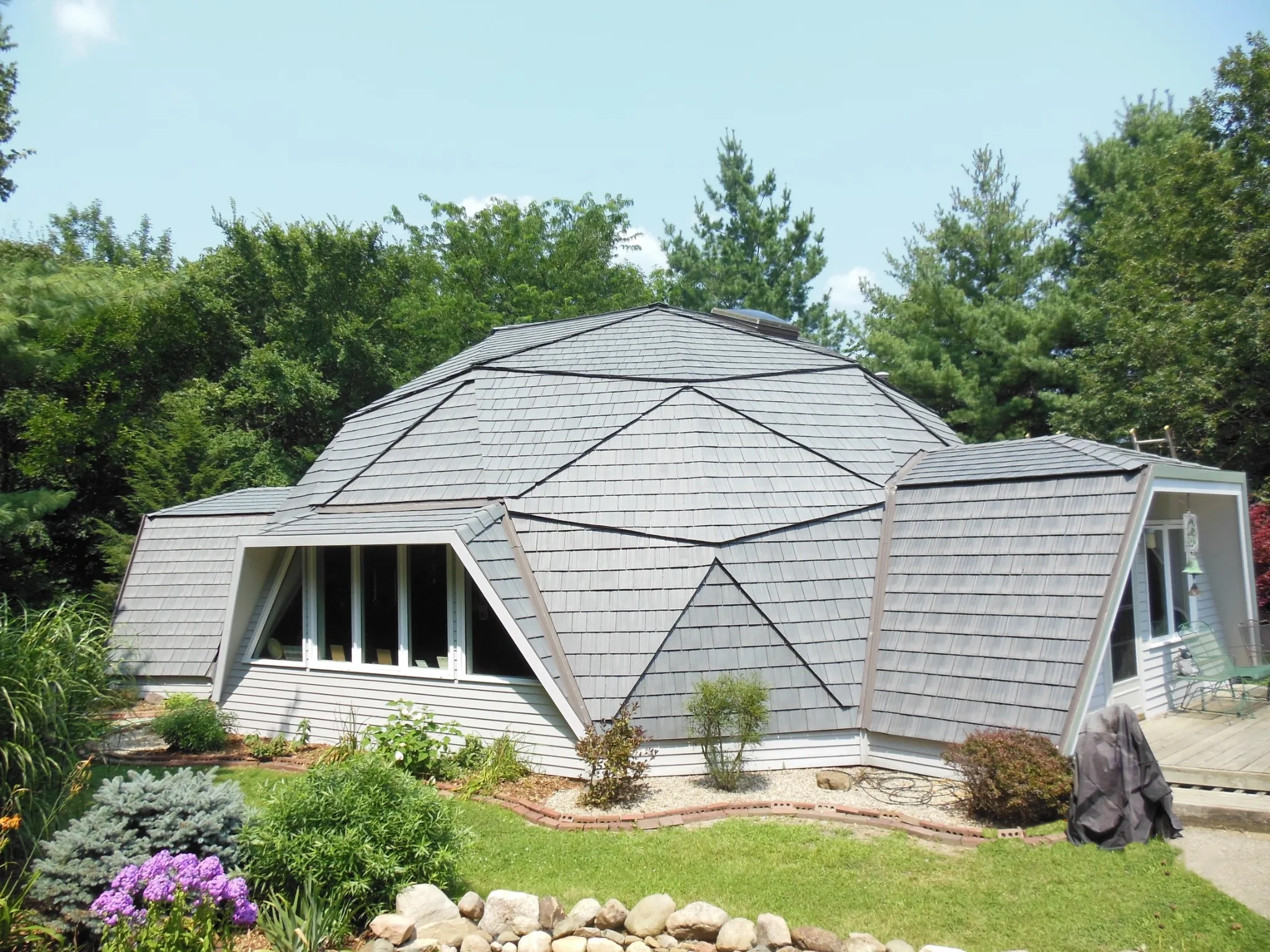
Faceted domes, gambrel profiles and other unconventional forms achieve their striking presence through a series of angled planes. Repeated shake courses lend these surfaces a consistent scale and texture, bringing natural warmth to a strongly geometric design. Because Enviroshake is cut to fit on site and available in multiple widths, it can adapt to each facet and transition, provided every section meets the selected product’s requirements, including a minimum slope of 2/12.
For architecture that calls for the refined look of slate, Enviroslate offers another premium option. Traditionally, slate was reserved for homes that could support its considerable weight. Enviroslate captures the elegance of natural slate at about one-third of the weight, with custom-formed hip and ridge tiles for slopes from 2/12 to 20/12 and the same Class 4 impact rating and 180 mph wind testing. It’s an ideal way to honor the slate tradition of Victorian and Tudor homes. Compare Enviroslate vs. natural slate.
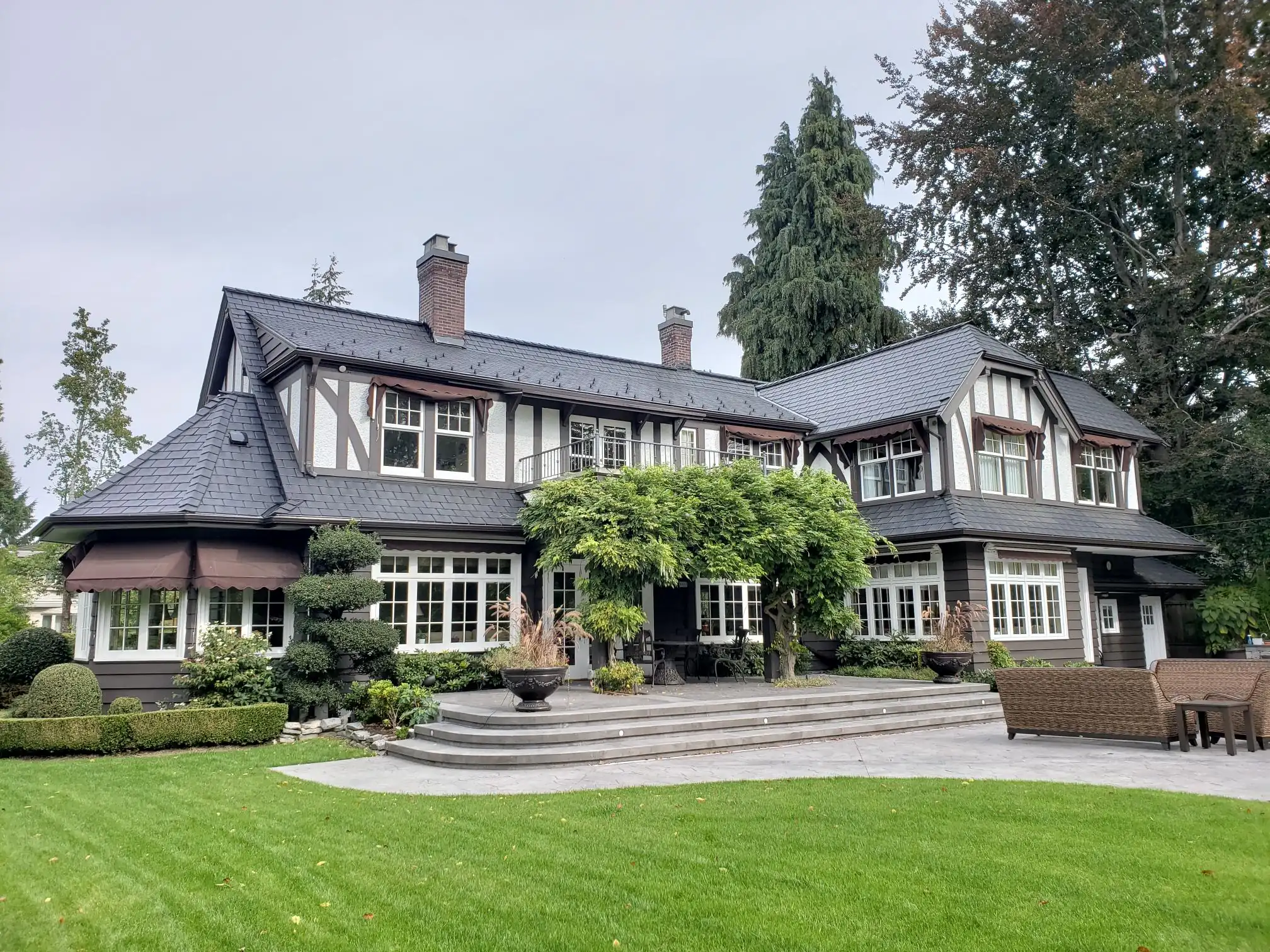
The right choice reflects both the aesthetic you envision and the application requirements of your roof. If you’re still deciding, our guide to which roofing material is right for your home can help.
Explore Enviroslate composite slate roofing
Planning for a Complex Roof
The features that make a roof beautiful are also the ones that deserve the most attention before installation. Changes in slope, narrowing roof sections, valleys and roof-to-wall junctions should all be reviewed with your contractor and Enviroshake early in the project. A thoughtful plan typically covers:
- Photographs and drawings. Begin with clear images or plans that show the roof’s turrets, curves, dormers and intersections.
- Slope. Enviroshake can be installed on slopes down to 2/12, with roofs at 2/12 following Enviroshake’s low-slope installation addendum.
- Roof deck and underlayment. Your contractor should assess the condition of the roof deck and specify the underlayment and flashing for each transition.
- Course layout and exposure. Plan how courses will wrap curves and turrets, and where exposure may be adjusted through transitions.
- Material quantities. Enviroshake recommends adding 10% for waste on a standard roof, and complicated rooflines may require more material for cutting.
- A qualified installer. Enviroshake must be installed by a Factory Trained Enviroshake Installer for the warranty to be valid, and Enviroshield underlayment qualifies the roof for the Gold Level Warranty.
Ask your installer to share comparable work and walk you through how they would approach your roof’s distinctive features. Enviroshake supports contractors with technical guidance and factory training to help every application come together as intended. When quotes arrive, our guide to what goes into a roofing quote explains how to compare them.
Review Enviroshake installation resources
Frequently Asked Questions
Can synthetic cedar shake be used on curved roofs, turrets and dormers?
Yes. Synthetic cedar shake suits roofs with turrets, dormers, curved sections and intersecting slopes when the roof design meets the product’s application requirements. On turrets, Enviroshake recommends split shakes to accommodate the curve. Enviroshake has been used to replace natural cedar on turret roofs, including a 120-year-old home in Sarnia, Ontario.
Will composite cedar shake look like a traditional cedar roof?
Enviroshake’s profiles derive from 3D images of real taper-sawn cedar shakes, replicating the depth, texture and grain of natural cedar. Varied profiles and factory-shuffled bundles recreate the natural variation of a wood roof. Learn more about synthetic cedar shake roofing.
Is composite roofing appropriate for a historic home?
Often, yes. Enviroshake’s Enviroshingle was approved for historic roof replacement in Aspen, where strict architectural review standards apply. Requirements vary by community, so check with your local historic commission or review board before you begin.
How much does composite cedar shake weigh?
Enviroshake weighs approximately 260 lbs per square (100 sq ft at a 9" exposure). For slate-style roofs, Enviroslate is about one-third of the weight of natural slate.
What photographs or drawings should I send to discuss my roof?
Send an overall view of the home along with clear photographs of its turrets, curves, dormers and roof intersections. Include roof plans, measurements and slope information if available. Your contractor can gather any details that aren’t visible from the ground.
Does every section of my roof need to use the same material?
No. Some designs pair shake with metal accents or a separate roof system for lower-slope sections. Each material should suit its location, with appropriate detailing where the systems meet.
Can synthetic cedar shake cover a very low-slope roof section?
Enviroshake’s minimum slope is 2/12, and roofs at that pitch should follow Enviroshake’s low-slope installation addendum. Sections below that slope will need a different roofing system, so your contractor should confirm the requirements for each part of the roof.
Can I keep my home’s existing roof shape when replacing cedar?
In many projects, yes. Replacing the roof covering doesn’t automatically require changing the home’s architectural form. Your contractor will first assess the existing structure and confirm that the replacement system suits its slopes and details. Read more about making the switch from cedar shake to Enviroshake.
Give Your Roof’s Architecture the Finish It Deserves
A turret, curved eave or series of dormers gives a home character worth preserving. For generations, that character was expressed in cedar and slate. Enviroshake makes it possible to carry the same texture, depth and timeless charm across every one of these features, while benefiting from the durability, low maintenance and lasting performance of engineered composite roofing.
“The roof looks fantastic. It is especially appealing on the house we built, as there are steep pitches of various gables and angles. That design reveals very substantial areas of roof surface, which allows the superior aesthetics of the Enviroshake product to shine.” – Harry Fox, PA
When you’re ready to take the next step, request a complimentary sample to experience the texture and color firsthand, share photographs of your roof with our team to discuss your project, or find a factory-trained installer near you.
Interested in learning more about Enviroshake products?
Contact us today to discuss your project and how we can help you achieve your design goals.
.webp)