What Goes Into a Roofing Quote? How to Compare Quotes
Key Takeaways
- You don't need to be a roofing expert to compare quotes, but you do need to know what each one includes.
- Before comparing totals, confirm each quote uses the same square footage, lineal footage, slope, exposure and waste factor.
- Exposure has a big effect on material: going from 9" to 7" means about 30% more product for the same roof.
- Accessories such as underlayment, fasteners, flashing, vents and snow guards are where quotes differ most, and some quotes leave them out.
- Enviroshake is happy to review any roofing quote with you and help spot the differences.
Roofing quotes for the same home can differ by thousands of dollars, often because they cover different materials and components. Reviewing the line items helps you compare the full scope of each quote and discuss pricing with your contractor or manufacturer.
Some quotes include only the primary roofing material, with underlayment, fasteners, and accessories priced separately or added later. A complete quote accounts for the components required for the installation, giving you a clearer picture of the total material cost. In this guide, we explain the main line items and how each contributes to the finished roof.
If you do nothing else: the 5-question checklist
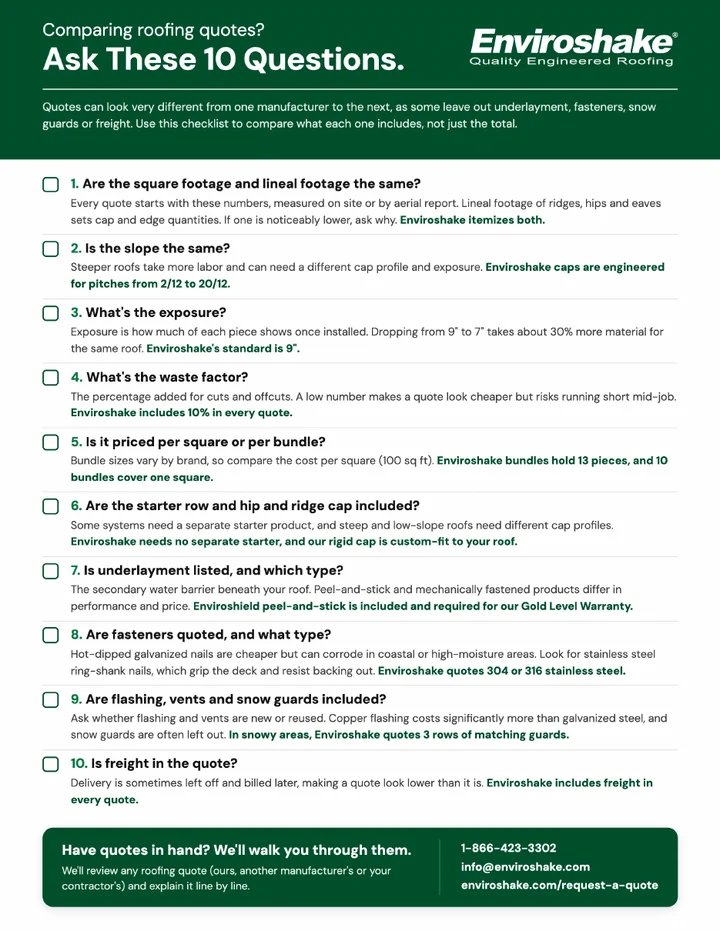
Ask every contractor these five questions. If the answers don't match between quotes, the quotes aren't pricing the same roof.
- What's the square footage? The total roof area being covered. Every material quantity starts here.
- What's the lineal footage of ridges, hips and eaves? This drives how much ridge cap, edge material and snow guards are needed.
- What's the slope? Steeper roofs take more labour and can change the cap profile and exposure required.
- What's the exposure? How much of each piece is left showing. A smaller exposure means more pieces per square foot.
- What's the waste factor? The percentage added for cuts and offcuts. We include 10%; some contractors use more or less.
How the roof is measured
The first thing your contractor will do is get the dimensions of your roof. Every quote is built on those measurements, so different measurements produce different prices. Contractors usually measure in one of two ways:
- Manually, by measuring the roof on site.
- With an aerial roof report, which calculates area, pitch and lineal footage from satellite or drone imagery.
Either method works. What matters is that your quotes use similar numbers. If one contractor's square footage is noticeably lower, ask why.
Roof complexity
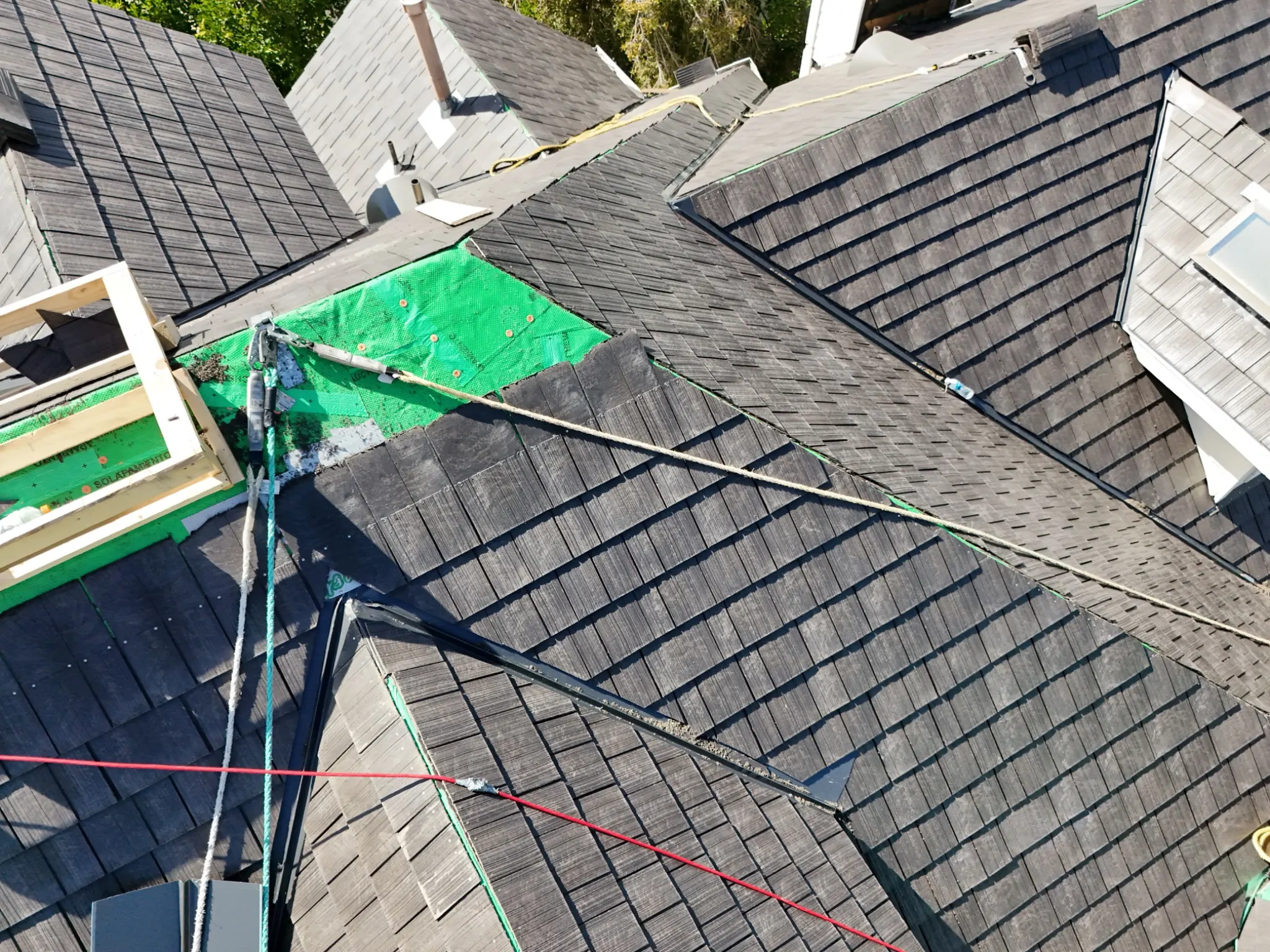
Is your roof cut up with lots of hips and valleys, or does it have simple roof lines? Dormers, curved sections, skylights and chimneys add complexity too. More cuts mean more labor and more material wasted, so expect a higher price and a higher waste factor on a complex roof.
Slope
Steeper roofs take longer and are harder to work on safely, so labor costs rise with the slope.
Waste factor
Most homeowners never ask about waste, but it changes the price of every quote. Enviroshake includes 10% waste in all of our quotes. Other contractors may quote more or less. A low waste factor makes a quote look cheaper but risks running short mid-job. Ask each contractor what percentage they used, and why.
Exposure: the difference most homeowners miss
Exposure is how much of each piece is visible once installed. Our standard is 9". Competitors may quote 10", 8" or even 7".
9" vs 7" exposure = about 30% more material
A smaller exposure means more pieces to cover the same roof. Always check the exposure before comparing prices.
Exposure has a significant effect on quantity. Dropping from a 9" to a 7" exposure means about 30% more material to cover the same roof. Some products must change exposure based on slope, but the quote may not reflect that. Confirm that the exposure you're quoted is covered under the manufacturer's warranty for your roof's slope.
Materials
Roofing components
The roofing material in a quote has three parts:
- Field tile: the main roofing pieces. The quantity should include the waste allowance for cuts around valleys, edges and chimneys, since not every offcut can be reused.
- Starter row: some systems use a separate starter product along the eaves. Ours doesn't, but other quotes may list it.
- Hip and ridge cap: caps finish and protect the lines where roof slopes meet. A steep roof and a low-slope roof need different cap profiles. Our cap is more rigid, so we custom-fit it to your roof, with caps engineered for pitches from 2/12 to 20/12.
Bundles
Roofing products are not packaged the same way, which makes price per bundle hard to compare. We show pricing per bundle: each bundle holds 13 pieces, and 10 bundles cover one roofing square (100 square feet). Competitors may use larger bundles at a higher price per bundle. Compare the cost per square, not the cost per bundle.
Product and color
Ask which product line and color each quote is based on:
- Standard product or premium product?
- Standard color or premium color?
- Single-width or multi-width?
Multi-width products use smaller pieces, so installers can handle up to twice as many pieces. That means more labor.
Accessories
Accessories are where quotes differ most. Not every quote includes them, so check each one line by line.
- Flashing and vents: is the contractor quoting new flashing and vents, or reusing what's there? Is the flashing copper or galvanized steel? Both are metal flashing, but copper costs significantly more. Vents also vary widely in price, so ask which ones are included.
- Underlayment: a secondary water barrier between the tiles and the roof deck. Peel-and-stick and mechanically fastened underlayments are different products at different prices. Our Enviroshield synthetic underlayment is included because it's required for our Gold Level Warranty.
- Fasteners: we quote stainless steel (304 or 316 grade). It's the best quality, won't corrode, and should last as long as the roofing itself. For optimal performance, look for ring-shank nails: the rings along the shank grip the roof deck and resist backing out, giving the strongest hold. Hot-dipped galvanized (HDG) nails are cheaper, but we'd never recommend them in coastal or high-moisture areas, where corrosion can weaken their hold. Buckets hold different quantities, so compare the count, not the number of buckets.
- Snow guards: hold snow in place to reduce sudden slides over entrances and walkways. In snowy areas, we quote a premium snow guard that matches our system, in a 3-row pattern along the full length of the eaves. You can choose to reduce them to high-traffic areas or remove them, though we don't recommend going without snow guards in snowy areas. Some competitors don't quote snow guards at all, which makes their total look lower.
- Installation accessories: tools such as a gapping tool keep the correct spacing between tiles during installation.
Warranty
Ask each contractor whether the installation plan they've quoted meets the manufacturer's warranty requirements, including the exposure, underlayment and fasteners. A quote that cuts a required component can put your warranty at risk. Enviroshake quotes include the components required for our Gold Level Warranty from the start.
Labor, deck, freight and disposal
Type of contractor
- Large contractors (branded trucks, uniformed crews) carry more overhead, which shows up in the price. They may finish the job faster.
- Smaller contractors often have lower overhead, and the owner may be part of the install crew.
Neither is automatically better. Just know that overhead is part of the price you're comparing.
Roof deck
Ask whether the roof deck (the wood under your roof) is being replaced, repaired or left as is. Deck work can add significant cost, and some quotes only price it once the old roof is off.
Freight
Is delivery included? We include freight in our quotes. Different truck types can be quoted depending on your site and access.
Disposal
Is removal and disposal of the old roof included? If not, budget for it separately.
What to compare across quotes
Line up each quote against this table. Any item that's missing or doesn't match is a question for that contractor.
| What to compare | What to ask | Enviroshake quote |
|---|---|---|
| Square footage | What total roof area is this quote based on? | Itemized in your quote |
| Ridge, hip and eave lineal footage | How many lineal feet of each? | Itemized in your quote |
| Slope | What pitch was used, and does it change the cap or exposure? | Caps engineered for 2/12 to 20/12 |
| Exposure | What exposure is quoted, and is it warranted at my slope? | 9" |
| Waste factor | What percentage is added for cuts? | 10% in every quote |
| Bundle coverage | How many square feet does each bundle cover? | 13 pieces per bundle, 10 bundles per square (100 sq ft) |
| Starter row | Is a separate starter product included? | Included in field tile quantities, not a separate line item |
| Hip and ridge cap | Is cap included, and what profile? | Rigid cap, custom-fit to your roof |
| Underlayment | Peel-and-stick or mechanically fastened? | Peel-and-stick synthetic underlayment (Enviroshield), required for the Gold Level Warranty |
| Fasteners | Stainless steel or hot-dipped galvanized (HDG)? How many? | Stainless steel, 304 or 316 grade |
| Snow guards | Are they quoted at all? What type, and in what pattern? | Premium matching guards, 3 rows along the full eaves in snowy areas |
| Flashing and vents | New or reused? Copper or galvanized steel? Which vents? | Confirm with your installer |
| Warranty | Does the whole installation plan meet the manufacturer's warranty? | Gold Level Warranty components included |
| Roof deck | Is the deck being replaced, repaired or left as is? | Confirm with your installer |
| Freight | Is delivery included? | Included |
| Disposal | Is removal of the old roof included? | Confirm with your installer |
Let us help you compare
As roofing experts, we can help pick up on the small differences between quotes. We're happy to review any roofing quote and go over the nuances with you, whether it's ours or not. Contact Enviroshake to walk through your quotes, or to request a project-specific quote of your own.
Interested in learning more about Enviroshake products?
Contact us today to discuss your project and how we can help you achieve your design goals.
.webp)